

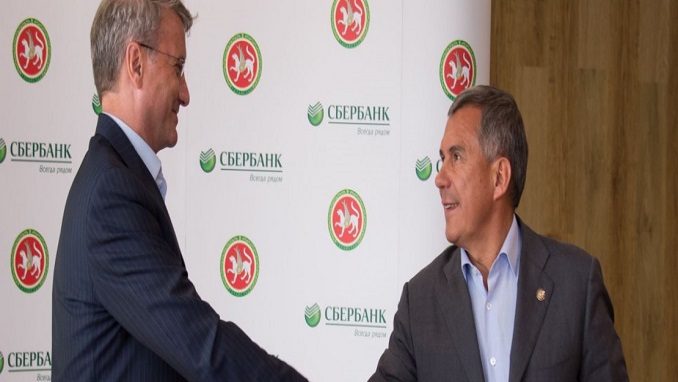

Russia’s largest savings bank Sberbank wants to set up a testing site on the base of the bank of Russia in the republic of Tatarstan to develop Islamic banking, Bekhnam Gurban-Zade, adviser of the Deputy CEO of Sberbank told TASS. Speaking on the sidelines of the 10th international economic summit “Russia-Islamic world KazanSummit 2018” he said:
“We want this site to be established on the basis of the Central Bank in the republic of Tatarstan, so that it is possible to test Islamic (banking) products and services,” he said.
In February, Oleg Ganeev, deputy chairman of Sberbank’s board told reporters that the banks was considering an option to launch the so-called “Islamic windows” in its offices to serve customers of Islamic banking in the near future.
“We are currently working with KPMG on Islamic windows, they are preparing a strategy for us, how and where to open them and what products to offer. In think that in June we will have the strategy and will be developing the relevant plan of activities. We will start from Kazan, Grozny and Ufa,” Gurban-Zade said.
Distinct from traditional banking, Islamic financing implies that banks do not provide loans to businesses at interest but invest money in their projects. Entrepreneurs carrying out projects and banks share the profits and risks. Islamic banking is widely applied in Southeastern Asia and in the Middle East.
According to Reuters, Russian banks want to develop Islamic finance to attract investors from the Gulf and Southeast Asia, underscoring efforts to widen funding sources strained by an economic crisis and Western-imposed sanctions. Vnesheconombank and Tatfondbank are also developing Islamic finance products. Lobbying by Sberbank, majority owned by the central bank and holding around a third of domestic bank deposits, could be key to the development of Islamic finance in Russia where retail demand has so far been untested. Only about 20 million of its 145 million people are Muslims.
Until now, Sberbank has explored Islamic finance within existing regulations but it plans to present draft regulatory changes to authorities by the end of the year, Oleg Ganeev, deputy chairman of the executive board, said via e-mail. Legislation will need to be passed in Russia to make Islamic finance cost-effective. Taxation is often an obstacle for Islamic finance transactions, which can attract double or triple tax duties since they require multiple transfers of underlying assets.
Sberbank started testing last year pilot transactions in leasing, financing food production and trading, after closing a maiden Islamic finance deal last year, Ganeev said, adding that a decision on whether to set up a separate entity could come by next year.
“There are 3 landmark projects in the pipeline. One is a local project in the energy-saving sector and two projects are with trading counterparts from GCC (Gulf Cooperation Council).”
Its first sharia-compliant deal was structured for a leasing company in the largely Muslim Tatarstan region, with a financing limit of 45 million roubles ($775,000). The transaction used a mudaraba contract, a form of Islamic investment management partnership where one party provides funds while the other provides expertise and management. In June 2017, its mudaraba product received certification from Shariyah Review Bureau, an Islamic advisory firm licensed by the central bank of Bahrain. Local businesses could also consider issuing Islamic bonds, or sukuk, as they have a variety of
Read more at TASS