

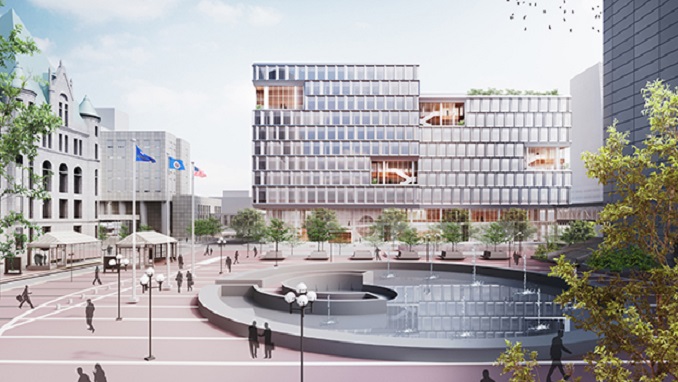

This week the City of Minneapolis sold its first-ever green bonds, worth $96.22 million, to finance portions of two high-profile public LEED Gold facilities soon to be under construction. “Green bonds” means the proceeds are used for environmental, social and sustainable objectives under guidelines determined by the International Capital Markets Association.
Green buildings, also known as low-carbon buildings, are an eligible project type under the Green Bond Principles. Both the new consolidated Public Service Building and the East Side Storage and Maintenance Facility, a state-of-the-art recycling and waste facility, will save significant energy, create less greenhouse gases than standard construction and catalyze other developers to meet similar standards.
Minneapolis joins Saint Paul as the first cities in the state to issue green bonds. Green bond designation can help the City reach the goals and strategies in its Climate Action Plan while at the same time possibly achieving a lower interest rate on bonds to save taxpayer dollars and helping to expand the market for green bonds to support action on climate change.
While these bonds are sold, the City would like to encourage people with investment dollars to ask their investment providers how to buy green bonds to further support action on climate change.
In its Climate Action Plan, the City identifies a strategy to demonstrate leadership in green buildings.
The Public Service Building is expected to reach a LEED Gold or higher certification in consolidating several departments currently at several sites into one modern, energy-efficient building accessible by mass transit. The design emphasizes low energy use, natural daylight and minimal impacts to migrating birds.
With the East Side Storage and Maintenance Facility — also to reach LEED Gold or higher—the City will construct a state-of-the-art recycling and waste facility combining operations from two outdated City facilities into one location. It will help with increased solid waste and recycling responsibilities due to population growth and expand the City’s recycling and composting operations. It has the additional environmental benefit of allowing the City to convert the vehicle fleet to compressed natural gas.
Each spring and fall the City sells bonds to finance portions of its capital budget. Refunding bonds work similarly to the way a person might refinance a home, meaning the City refunds bonds it sold years ago by selling new bonds at lower interest rates.
Source Minneapolismn.gov