

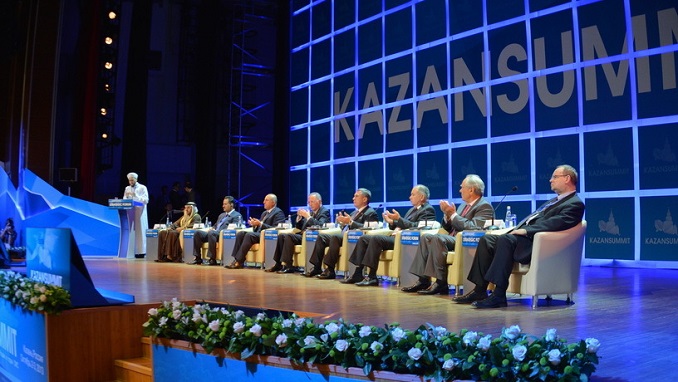

Tatarstan, an autonomous republic of the Russian Federation, is pushing hard to make its capital city Kazan a new center of Islamic finance for Russia and the region, Tatarstan President Rustam Minnikhanov says.
Answering a question from Capitol Intelligence/GCA at the KazanSummit between Russia and the Organization of Islamic Cooperation (OIC) several months ago, Minnikhanov said his government was pushing through legislation in the Russian Duma that would enable the issuance of Islamic financial instruments such as sukuks (Islamic bonds) on the Russian market.
As a concrete step toward bringing Islamic finance to Russia, Minnikhanov said Tatarstan and the KazanSummit had arranged a bilateral meeting between Central Bank of Russia governor Elvira Nabiullina and the president of the Islamic Development Bank (IDB), Dr Ahmad Mohamed Ali Al-Madani. Tatarstan is a Russian republic with a majority Muslim population, and is the site of the biggest mosque in Central Asia.
“The world should strive to make peace and not to sow discord between people or create instability in many countries, including [those with many] Muslims,” Minnikhanov said.
In particular, he highlighted that the IDB would be pleased to cooperate with Russia in the Republic of Tatarstan, in order to make Kazan and the region a source of development and economic expansion between Russia and the OIC member countries. Madani highlighted that Tatarstan would play a vital role in the relationship among members of the OIC countries, the Muslim world and the Russian Federation.
According to the UAE Economy Ministry, global sharia-compliant assets are expected to grow to US$3.3 trillion in 2021 from about $2.6 trillion in 2017. Linar Yakupov, the founder of the KazanSummit and the president of the newly established Kazan-based Islamic Business and Investment Fund (IBFD), said the summit started in 2009 as a very small event and people “never dreamt that one day it could become the event of national importance and people from all over the globe would be coming and taking part together with Kazan.”
In fact, Minnikhanov remarked that “when we started seven years ago taking about Islamic finance, everyone thought we [were] strange people talking about weird things. Now we have the chairman of [Russia’s largest bank] Sberbank, Herman Gref, wanting to talk to us.” Kazan has already attracted the attention of, and investment from, major companies and investment funds of Qatar, the UAE, Bahrain and Oman.
Tatarstan is one of the few regions to benefit from the current economic crisis in Russia caused by US and European Union sanctions related to the annexation of Crimea. The central authorities in Moscow and major Russian financial institutions had never given much thought about Islamic finance until now as the country seeks new sources of foreign capital and to avoid an over-reliance on funds and investment from Russia’s historic geopolitical rival and neighbor, China.
While legislation has been approved allowing for some forms of Islamic financial institutions in Russia, the market itself is struggling after the shutdown of Russia’s pilot Islamic bank, the Partnership Banking Center in Kazan, for lack of liquidity and reports of fraud at its parent, Tatagroprombank.
Minnikhanov said he expected the legislation to become fully effective by year-end but did not exclude the Kremlin fast-tracking it, considering the lobbying efforts by the Tatarstan president, arguably the third-most-powerful man in Russia after President Vladimir Putin and Prime Minister Dmitry Medvedev.
Madani said: “Tatarstan could be promoted as the ‘Islamic finance hub’ in the Russian Federation, and the IDB will help the Russian Federation in developing a full-fledged master plan for Islamic finance.”
While Russian parliamentary approval for Islamic finance seems to be a given, some at the KazanSummit had doubts whether Kazan was ready and prepared to issue Islamic financial products and compete with major centers for these products such as London and Dubai.
Aidyn Tairov, chief financial officer of Almaty, Kazakhstan-based Al Hilal Bank, said he believed it would be a great challenge for Kazan to become the center of Islamic banking in Central Asia. But with the support of the Russian central bank, the mission of making Kazan the center of Islamic banking for Russia, and possibly the region, becomes a more realistic possibility, Tariov said.
Some may dismiss the feasibility of Kazan and Tatarstan becoming a global center of Islamic finance given its isolation from major financial centers, Russia’s relatively small Muslim population (about 20 million), and the novelty of Islamic finance in Russia. However, there are very deep ties between Kazan and the most innovative practitioner of Islamic finance, Malaysia, due to the long history of Malaysia sending students to the University of Kazan. Delegates attending the KazanSummit remarked that they felt Tatarstan, especially its efforts to promote religious tolerance and economic growth, was a neutral place for Muslims to discuss Islamic finance and economic cooperation.
“Whenever someone talks about creating an Islamic financial capital, everyone wants it to be headquartered in their country, whether it be Kuala Lumpur, Dubai, Jeddah, Almaty and even London,” a senior Islamic-finance official said. “But when you mention Kazan, people do not see it as a loss of prestige or a threat.”
European insurance giant Allianz AG has already begun selling Islamic finance insurance and investment products on the Russian market in cooperation with US asset-management giant Blackrock, Allianz Russia deputy head of sales Vladimir Trukhin said.
It may take a decade for Kazan to become a rival to Dubai or London in the issuance of sukuks and Islamic finance, but its ability to bring out the best brains in the Islamic finance world has already been seen. Tatarstan is a small republic with great ambitions. One topic discussed on the sidelines of the KazanSummit was the creation of Islamic-compliant derivative exchange trading so Muslim commodity producers can effectively hedge their risks as do others in the West.
Source Asia Times