

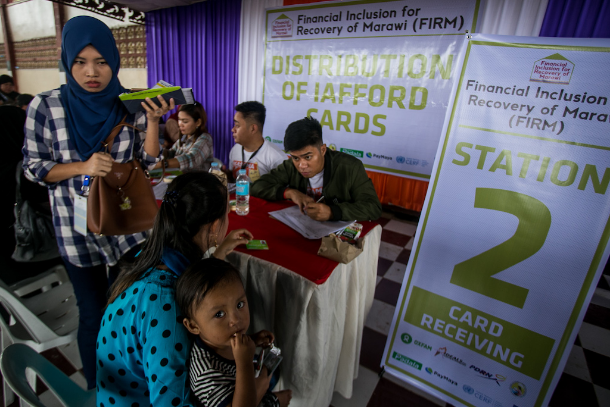

Victims of the five-month war in the southern Philippine city of Marawi in 2017 finally have access to financial services and Islamic finance a year after the conflict ended. A consortium of humanitarian groups distributed cash cards, which also serve as personal saving accounts, to at least 17,000 beneficiaries in the city on Nov. 28.
One of those who benefited from the “Financial Inclusion for the Recovery of Marawi” project is Monera Candidato, a mother of 13 from an evacuation center in the town of Baloi. Candidato said she would use the cash she received as capital for her small business of selling firewood to fellow internally displaced persons.
“If my child doesn’t have milk or if my child needs the fare to go to school, I sell firewood. Without the money I used for capital, we won’t have anything to sell and we won’t have anything to sustain us,” she said.
Rakima Edris, also from a temporary shelter in Baloi, said she would use the money to start a small business.
“The help came just in time,” she said, adding that she has been struggling to support her family since her husband died early this year.
The project aims to help displaced families from Marawi meet their basic needs by restoring livelihoods and ensuring access to safe, transparent and Sharia-compliant financial services.
“By providing access to capital to fund small businesses, we help families affected by the Marawi crisis to rebuild their lives. The cash card also aims to encourage the families to invest and motivate them to save money in a banking system that complies with Islamic law,” said Maria Rosario Felizco, country director of Oxfam in the Philippines.
Esteban Masagco of the non-government People’s Disaster Risk Reduction Network said the humanitarian response to the Marawi crisis has progressed to development work.
“We use technology to provide a culturally and religiously suited digital banking service that promotes financial inclusion, especially to the poorest of the poor,” he said.
The 8-month project has already provided access to financial services to 17,000 families affected by the Marawi crisis, including 11,200 families who received cash grants. The grants were disbursed through the “Inclusive and Affordable Financial Facilities for Resilient and Developed Filipinos” cards distributed to recipients.
The cards, which also serves as identification cards, allow families to save money, pay bills, and purchase food and other items at any Visa and PayMaya-accredited stores nationwide. They also allow families to access future assistance from the government and aid agencies. Aside from cash assistance, the project has conducted financial literacy and Islamic finance orientation sessions to families affected by the Marawi crisis.
An estimated 93 percent of cities and municipalities in the Autonomous Region in Muslim Mindanao, including the city of Marawi, still have no access to banking institutions. In May 2017, a local terror group that claimed to have links with the so-called Islamic State occupied Marawi, resulting in the displacement of about 360,000 people.
Source UCA News