

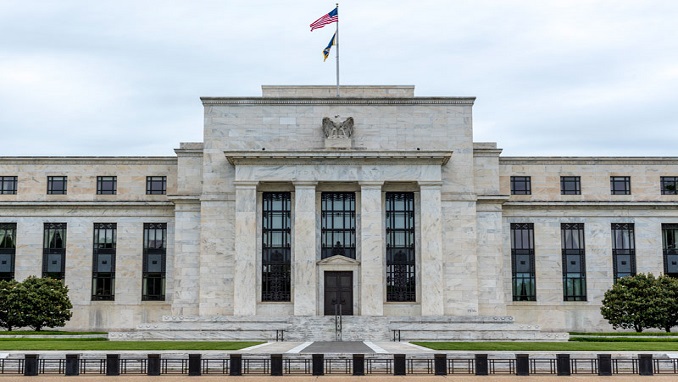

In its last meeting on March 20, the Federal Reserve (Fed) stuck to its mantra that it can be patient in waiting to hike interest rates. Despite economic fundamentals in the US being good at present, and the fact that growth is expected to be around two percent this year, uncertainty still remains.
This stems from a variety of places: US-China trade talks; deteriorating earnings and productivity forecasts; record-high debt levels; shaky market micro-structure; the need to leave Quantitative Easing behind; geopolitical volatility and a global slowdown in growth. Together, these events signal an increased chance of recession, which could hit at some point at the end of this year or in 2020.
The fixed income market in the GCC region is inversely related to the movement of oil prices. Consequently, central banks, and the Fed in particular, must maintain their cautious stance. Markets, meanwhile, will continue to keep a close eye on the updated dot-plot by the Fed, which indicated no further rate hikes in 2019 and only one in 2020.
On March 7, the European Central Bank (ECB) announced that it would keep interest rates on hold, and made a fresh offer of cheap funding via loans called Targeted Longer-Term Refinancing Operations for the bloc’s banks. Back in January, the ECB had announced that rates were expected to remain at their current level “at least through the summer of 2019”.
But amid escalating concerns about a slowdown in Eurozone growth and productivity, it has since indicated that this forecast will be extended, with many experts predicting it will hold until mid-2020 at the earliest. The bank also held its benchmark refinancing rate at zero, while keeping the deposit rate at -0.4 percent.
Against this backdrop of slowing economic growth, weaker-than-anticipated demand for crude oil is pushing the oil market deeper into bear territory. At present, there are fears and concerns – especially in regards to China – about where demand for oil is heading.
When preparing his negotiators for a fresh round of talks, on March 22, President Donald Trump said that a trade deal with China is close. Despite this, together with the fact that trade tensions are negatively influencing Chinese economic growth, US officials have downplayed the possibility of a swift conclusion.
Meanwhile, the Paris-based International Energy Agency predicts that oil demand will grow by 1.4m barrels per day (bpd) in 2019, while the US Energy Information Agency believes the world will consume an additional 1.5m bpd in 2019. OPEC’s forecast for 1.3m bpd in demand growth in 2019 is more realistic, but perhaps too optimistic.
For JP Morgan, the outlook is even darker. The investment bank sees the world’s appetite for oil growing by just 1.1m bpd this year.
“The demand growth is expected to weaken again in 2020,” said Abhishek Deshpande, head of oil market research and strategy at JP Morgan, according to CNBC.
How can this be translated into the sukuk market? The fixed income market, in particular the frequency in issuances of bonds or sukuks, in the Gulf Cooperation Council (GCC) region is inversely related to the movement of oil prices.
Higher oil prices are enabling some GCC nations to continue their usual spending, namely, to sink their borrowing requirements through debt capital markets, support their budgets by financing their deficits, and to improve liquidity in their banking systems.
According to Fitch Ratings, which calculated the ‘break-even’ oil price at which Gulf states were able to balance their budgets in 2018, the average for the year varied between $98 a barrel in Bahrain, $53 in Kuwait, $85 in Oman, $78 in Saudi Arabia, $62 in Abu Dhabi and $64 in Qatar.
Both the current and forecasted price of oil is set to encourage sukuk issuances in the GCC as an attractive option for financing government spending. Indeed, there is growing confidence in the sukuk that it could end up being the most widespread financial instrument of the entire Islamic banking industry.
Gulf banks, which benefit from the current low interest rate level, are expected to issue Tier 1 or Tier 2 sukuks to strengthen their capital base, in accordance with Basel III requirements for higher liquidity coverage ratios.
Over time, the sukuk market will become increasingly established, particularly as more sukuks come to market, attracting conventional and Islamic investors alike. This trend will also see liquidity that used to be invested in developed markets invested in emerging markets and the GCC instead. In turn, this growth will assist in shaping and determining the pricing level for the future issuance of sukuks.
Moreover, the growth of sukuk issuances could be boosted when more central banks, regulatory and government bodies, and financial institutions (whether conventional or Islamic) join and support relevant non-profit organisations.
One such example is the International Islamic Financial Market, which has brought tremendous benefits to the Islamic banking industry by promoting Sharia harmonisation, reducing legal and Sharia compliance related costs, and strengthening risk management capabilities. The organisation also educates international investors and issuers through seminars and workshops, increases efficiency in resolving differences and disputes, and encourages standard legal documentation to grant reliable investors security.
As a result, more players are realising the credibility and profitability of the sukuk by increasing cross-border financial deals in the region, which, in turn, will help achieve greater growth for sukuk issuances.
Source World Finance