

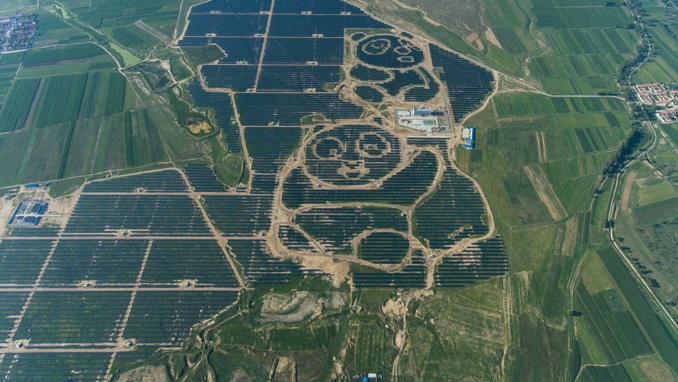

China is hosting its second Belt and Road forum in Beijing from April 25-27, convening high-level representatives from around the world. The event will be a chance for China to evaluate the first five years of President Xi Jinping’s signature Belt and Road Initiative (BRI), a trillion-dollar international investment project, and provide more specific targets and roadmaps for future projects.
In the lead-up to the first Belt and Road forum in May 2017, China published its “Guidance on Promoting Green Belt and Road,” “Belt and Road Ecological and Environmental Cooperation Plan,” and “Vision and Actions on Energy Cooperation in Jointly Building Silk Road Economic Belt and 21st-Century Maritime Silk Road,” emphasizing that its investment projects will be used to promote the Paris Agreement and 2030 Sustainable Development Goals and are motivated by the need to “share the ecological civilization philosophy and achieve sustainable development.”
Meanwhile, energy demand in Belt and Road countries is expected to grow. As pointed out in a recent NRDC report, based on BRI countries’ targets for renewable energy, the projected installed capacity of renewable energy for 38 countries in BRI could reach 644 GW from 2020-2030, and total investment in wind and solar power could reach $644 billion.
However, currently renewable energy cooperation in BRI countries faces myriad challenges, including financing difficulties, low electricity pricing, and inadequate policy support, all of which have become major obstacles for BRI renewable energy development. One measure of success for promoting a Green Belt and Road should be the extent to which BRI helps countries increase access to low-carbon energy sources.
Despite official policy, BRI has come under continued criticism for promoting dependence on fossil fuels in developing nations and investing in environmentally damaging infrastructure projects.
While China has provided some financing for renewables projects overseas, including in Belt and Road countries, it is a small share compared to the percentage for other areas such as oil, gas and coal. According to a recent report by WRI and Boston University, out of the loans in the energy sector for BRI, 43 percent of state policy bank loans by the China Development Bank and Export Import Bank of China have gone to oil, gas and petrochemicals, 18 percent to coal, but only 3.4 percent to solar and 2.9 percent to wind from 2014-2017.
Additionally, Chinese companies’ direct overseas greenfield investments and acquisitions in the power sector in BRI countries from 2015-2017 included only USD$5.5 billion for wind, USD$7 billion for solar, but about USD$33.5 billion for coal, oil, and gas-fired power plants.
Fortunately, there is a huge window of opportunity to increase investments in renewable energy through BRI. This engagement could be in the form of loans to support specific renewables projects, acquisitions and equity investments by Chinese companies overseas, Chinese engineering, procurement and construction (EPC), or the export of Chinese solar or wind equipment overseas.
There are many ways in which China has engaged in renewables projects overseas, and there is overlap in categories as projects with Chinese financers often have Chinese EPC firms and equipment suppliers. While the data below is not comprehensive, it is a first attempt to show the current trends.
When examining China’s investment in energy projects abroad it is helpful to look at the differences in lending between the Chinese state policy institutions and Chinese commercial institutions. State policy institutions include China Export and Credit Insurance Cooperation (Sinosure), China Development Bank and the Export-Import Bank of China. These institutions provide financial support for projects that are supported by Chinese government policy. Commercial banks include the Industrial and Commercial Bank of China (ICBC), Bank of China (BOC), and more. These banks, while they may be partially state owned, make lending decisions in a more traditional manner.
While wind and solar have both received support through project loans, financing for coal easily dwarfs support for renewables. Fortunately, the efforts to “green” the Belt and Road can help to drive financial flows towards more sustainable, profitable, clean, and low-carbon energy sources.
The bulk of Chinese renewables support through project loans is provided by Chinese commercial banks such as Agricultural Bank of China, Bank of China, China Construction Bank and Industrial Commercial Bank of China. Increased investment by China’s commercial banks in particular seems to reflect the growing profitability of renewable energy projects, as costs continue to decline for wind and solar projects worldwide.
China’s renewable investments abroad are not limited to BRI countries. Chinese financing for specific renewable energy projects has largely been in Australia and the United States. Victoria state in Australia has signed an agreement with China on BRI, but the United States has not. However, both have become key destinations for Chinese financing for solar and wind energy. According to our data, other destinations for Chinese renewables financing did include several BRI countries, such as the United Arab Emirates and Brazil, both of which have BRI cooperation agreements with the Chinese government.
Even though only a small percentage of China’s financing and direct investment in the energy sector through BRI is going towards renewables, there are already glimpses of the massive potential to scale up renewable energy investment by China through the Belt and Road Initiative, if the right policies are in place. The Cauchari Solar Plant currently under construction in Argentina is expected to produce 300 MW of power, expanding to 500 MW over time. The $390 million project is primarily being funded by the Export-Import Bank of China and Shanghai Power Construction is leading the construction using Chinese company Talesun’s solar panels.
Renewable investments are clearly a viable option for both government funds and Chinese companies and can go a long way in helping nations meet their domestic clean energy targets and intentions under the Paris Agreement.
In addition to the financing for renewables projects overseas, China is a major supplier of solar panels globally. According to Bloomberg New Energy Finance China exported 15 GW of solar panels to Japan from 2012-2017. Other top importers of Chinese solar equipment are the U.S., the Netherlands, and India. While Chinese exports focus largely on solar equipment, wind equipment exports to countries like Pakistan, South Africa, and the U.S. are also notable.
In the field of EPC, Chinese companies including PowerChina and Gezhouba Group worked on EPC for renewable energy in countries such as Laos, Nigeria, Ghana, and Guinea. In terms of concentrated solar power, SEPCOIII also cooperated on a CSP project in Morocco.
In terms of wind, PowerChina participated in the Dawood Wind Farm project in Pakistan as the developer and on EPC, and Chinese wind power companies including the China Three Gorges Corporation, the China General Nuclear Power Group, the China Energy Investment Company, Goldwind, Envision Energy, Ming Yang Smart Energy, etc. have participated in the investment and construction of wind projects in the UK, Germany, Australia, and others.
There is huge potential for China’s BRI renewable energy cooperation. China has formed an international development cooperation model for renewable energy, which consists mainly of overseas EPCs, opening production facilities overseas, overseas mergers and acquisitions, and overseas research and development.
It is clear that renewable energy investments are profitable, economically viable, and of the utmost importance for reaching our climate goals. It is in China’s own interest to focus on green development in BRI countries. It is true that many developing countries need to develop their energy infrastructure.
These energy systems then should be forward looking, emphasizing renewable projects that will remain profitable rather than coal which may result in stranded assets and ecological damage. China is already undertaking some of the kinds of clean energy projects BRI countries need. Now it is a question of scaling up to meet the greatest environmental challenge of our time – climate change.
Source NRDC