

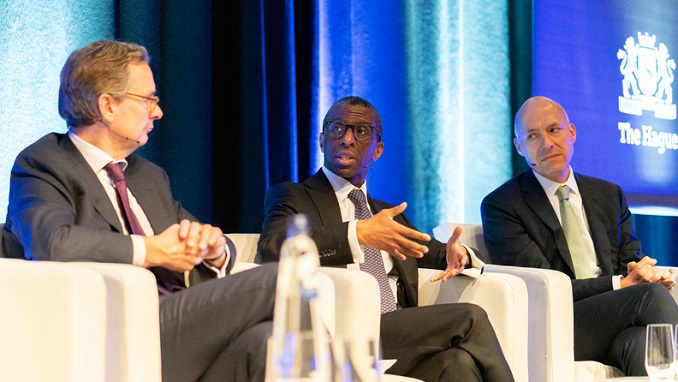

European pension fund executives say they are less concerned about the prospect of another global recession and more focused on identifying companies that have sustainable business models to secure positive returns.
Noting the decreased “firepower” of central banks globally, European investment officers who attended Pensions & Investments’ WorldPensionSummit held Oct. 22-24 at The Hague said companies could be facing challenges as a result of the global economic slowdown.
With rates at ultra-low levels, the scope to cut or normalize rates is curtailed for central banks, they said, adding that an increase in rates could contribute to higher levels of bankruptcy.
“The global financial crisis didn’t clear out fading companies quite as effectively as it should have” so the next slowdown will have a different impact as the effectiveness of central banks is reduced, said John St. Hill, deputy CIO of National Employment Savings Trust, the £8 billion ($10.3 billion) London-based multiemployer defined contribution plan.
Speaking on the same panel, Eloy Lindeijer, CIO of PGGM, the manager of the €238 billion ($263.6 billion) Pensioenfonds Zorg en Welzijn, Zeist, Netherlands, agreed.
“The monetary policy has been so loose that it has become a source of instability,” he said, expressing hope that Christine Lagarde’s arrival Nov. 1 as the new president of the European Central Bank will mean a review of the bank’s monetary policy.
But speakers agreed that neither monetary policy or economic slowdown should be investors’ main concern. Instead of focusing on recession, Mr. Lindeijer called on other asset owners to help develop a common “intellectual property” and share it so that investors can be more successful at harvesting the benefits of long-term environmental, social and governance investing.
“We want to identify the companies which contribute to (the United Nations’) Sustainable Development Goals through (PGGM’s) sustainable development investments’ initiative, which launches Jan. 1,” he said.
The initiative aims at developing a common methodology to find companies with sustainable business models and conditions under which other companies could be made to have a more resilient future, Mr. Lindeijer said.
However, asset owners based outside of Europe still question the link between climate change and company performance, said Tracy Stewart, corporate governance manager of research at the $206.9 billion Florida State Board of Administration, Tallahassee.
“There is not a lot of faith in the idea in the U.S. that (ESG) would lower risk and or commensurate to a greater return,” she said, speaking on a separate panel.
Ms. Stewart said U.S. asset owners differ from European peers in how they view climate change, adding that, for example, some of Florida’s staff asked her whether the selling of certain equities by ESG-focused investors could result in opportunities to invest in efficiently priced companies.
Speaking on the same panel as PGGM’s Mr. Lindeijer, Ronald van Dijk, managing director and head of capital market investments at APG Asset Management, the manager of the €399 billion Stichting Pensioenfonds ABP, Heerlen, Netherlands, said asset owners should consider outcomes of specific companies rather than avoiding entire sectors when discussing a reduction of carbon dioxide emissions with their portfolios companies.
Florida’s Ms. Stewart, who spoke on a separate panel, said some U.S. investors could be “disruptive” to global engagement efforts over climate change since these investors often publicly vote on shareholder proposals in a way that is contrary to the objective of having an emission reduction target.
Speaking on the same panel as Ms. Stewart, Christian Kjaer, vice president and head of liquid markets at the 933 billion Danish kroner ($138.3 billion) ATP, Hilleroed, Denmark, said:
“We started to look for companies which are going in the right direction that try to disclose emissions and are proactive about their (climate) strategy.”
Mr. Kjaer added that ATP’s experience showed that looking at multiple ESG datasets or scores supplied by external vendors used in combination with an internal analysis of performance drivers has helped to improve overall performance.
Still, Nadine Robinson, technical director at non-profit organization Climate Disclosure Standards Board, which supplies information about financial markets to investors, said investee companies are currently only partially disclosing information to investors.
Speaking on a separate panel to Mr. Kjaer, she said: “Out of 11 recommended disclosures, we are getting 3.6 disclosures on average. Companies are not giving a full picture as to how they are managing and identifying climate risk.”
Two-thirds of investors who voted in a session on Oct. 23 said in a live poll that their ESG integration efforts depended on demand from plan participants. Some 42% of attendees named collaboration with peer investors as a key factor in ESG integration, while 37% were prompted by regulatory requirements.
Reflecting on a growing influence of the global investor community on how U.S. plans are approaching ESG, Florida SBA’s Ms. Stewart said: “I’m seeing a shift in how our (staff) are thinking about ESG,” noting the impact of interacting with global money managers that have more experience catering to the ESG needs of European investors.
But Gregoire Haenni, CIO of the 14 billion Swiss francs ($14 billion) Caisse de Prevoyance de l’Etat de Geneve noted a need to develop a common taxonomy for evaluating ESG investments, which the European Commission is set to supply under a new disclosure regulation.
Appearing on the same panel as Ms. Robinson, Mr. Haenni said: “If I talk to fellow (pension funds), some have 20% allocation to impact investing (strategies) and some have 2%. On those (asset owners) who have 2%, beneficiaries are putting pressure to get to that 20%.” However, he said, “some of these pension funds are counting exclusions as impact investing.”
Source Pensions&Investment