


Islamic finance is set to keep expanding in 2020 and beyond as the GCC countries and Malaysia help drive growth in Shariah-compliant financial products; however, there are downside risks from the coronavirus (COVID-19) outbreak, according to rating agency Moody’s.
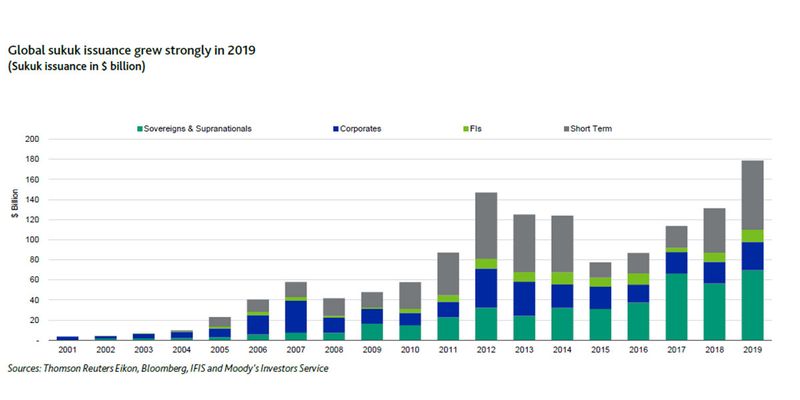
“We expect Sukuk issuance to remain stable at around $180 billion this year, and the takaful insurance market will see steady growth as insurance premiums pick up in newly penetrated markets,” said Nitish Bhojnagarwala, VP-Senior Credit Officer at Moody’s. “However, downside risks are rising because of the coronavirus outbreak, as prolonged market disruption could dissuade issuers from coming to market.”
The rating agency expects flat growth in total global issuance this year after a 36 percent rise in 2019 to $179 billion.
Strong growth in GCC
According to Moody’s in the GCC, Islamic finance penetration increased over the last decade to 44 percent as of September 2019 from 32 percent in December 2009. The main driver was retail demand for Shariah-compliant financial services, which powered strong financing growth of around 6.2 percent in compound annual terms in the last three years, compared with a 4.5 percent increase in conventional bank financing.
“In addition to customer demand, proactive government legislation, and mergers and acquisitions have driven growth in Islamic banking assets. In the GCC, there has been a flurry of acquisitions and consolidations in the past two years. In some cases, Islamic banks are acquiring conventional banks and emerging as the surviving entity, substantially adding to their asset bases,” said Bhojnagarwala.
The merger of Barwa Bank and International Bank of Qatar completed in April 2019 created the third-largest Islamic bank and sixth-largest bank in Qatar, with an estimated market share of 6 per cent of total loans and assets of around $22 billion. In Kuwait, the merger between Kuwait Finance House and Bahrain-based Ahli United Bank once completed, is likely to create the world’s largest Islamic bank, surpassing Saudi Arabia-based Al Rajhi Bank.
Saudi-led growth
The penetration of Islamic finance in Saudi Arabia is increasing rapidly from already high levels. Growing demand from corporate and retail clients for Shariah-compliant products and a supportive regulatory environment with coordination between the Ministry of Finance, Saudi Arabia Monetary Authority and the Capital Market Authority are propelling the increase.
Moody’s expects Islamic finance penetration in Saudi Arabia to increase to 80 per cent of system-wide loans (including both conventional and Islamic financing assets) over the next 12-18 months, from 77 per cent in 2018, driven by increased demand from both corporate and retail clients.
In Saudi Arabia all the domestic banks are now either fully fledged Islamic banks or have Islamic windows.
Oman remains the fastest-expanding Islamic banking market in the GCC, with a growth rate of 10 per cent in the first nine months of 2019. Despite only introducing Islamic financial services in 2012, the sector now has two standalone Islamic banks and six Islamic windows at conventional banks offering Islamic services. As a result, the sector’s market share has risen from zero to around 15 per cent of banking system financing assets as of September 2019 and still has potential for further growth.
Islamic banking penetration in the core Islamic financial markets of GCC, Malaysia, Indonesia and Turkey, increased to 31.2 per cent in September 2019, from 25.5 per cent in 2013.
Source: Gulf News