

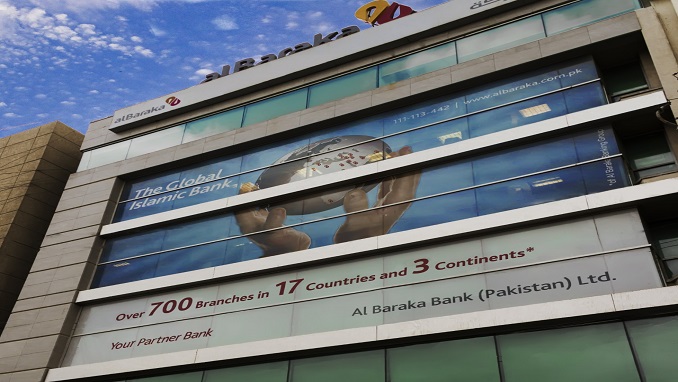

As soon as you click on the link for Al Baraka Bank’s website, the first thing you will see are two ornate, and very Islamic-looking doors parted slightly, with light bursting through the crack between them.
“Opening the doors of Baraka,” the caption to the picture reads. Baraka, of course, means blessed, and if it was not clear from the name, the website is a pretty clear giveaway that the bank is an Islamic bank.
And while the bank may claim to offer its customers light-filled, Sharia-compliant banking services, its own historical trajectory has been anything but blessed. For one of the oldest Islamic banks in the country (having been around in some iteration since 1992), it is also one of the smallest banks in the country, commanding only 0.9% of total industry deposits in 2019.
This paltry share in the market is even more surprising given the rapid success of Pakistan’s Islamic banking sector.
Islamic banking in Pakistan has grown in the last two decades from just two at the start of the 2000s, to now, 22. Similarly, Islamic banking constituted just 0.8% of all banking deposits in 2003, but accounted for 18% of total deposits in 2019.
The spectacular consumer interest in Islamic financing has changed the trajectories and size of banks that offer Islamic finance. Undoubtedly, the greatest beneficiary has been Meezan Bank, which in 2019 was the sixth largest bank in terms of deposits.
One can see this growth reflected in deposit numbers as well. Between 2003 and 2018, deposits in the conventional Pakistani banking system grew at an average rate of 20.2% per year, according to data from the State Bank of Pakistan (SBP), from Rs1.8 trillion to Rs13.4 trillion.
That looks impressive, until one looks at the growth rate of the Islamic banking sector: during that same period, deposits at Islamic banks and Islamic banking windows of conventional banks grew at an average of 65.1% per year, or from Rs14.4 billion to Rs2.2 trillion.
Banks like Meezan bank were started in 2003, giving Al Baraka bank a whole decade of a head start. And yet, despite two acquisitions in the last two decades, the bank has struggled to gain a footing in the banking sector.
Why was this bank not able to capitalize on being one of the first Islamic banks in the country?
If you are one of the people responsible for the bank at either Al Baraka Bank Pakistan or the Al Baraka Banking Group, they are difficult questions to face up to. Al Baraka Banking Group did not respond to request for comment, while Al Baraka Bank Pakistan declined to comment. But results often speak for themselves, and we were still able to piece together what happened.
Source Pakistan Today