


China has pledged to fill the global infrastructure development gap with more than US$4 trillion in “sustainable” projects through its Belt and Road Initiative (BRI). But China is not delivering on its promises of green and low carbon infrastructure so the initiative is facing a crisis of legitimacy.
According to a recent report from the World Resources Institute, about 75 per cent of the US$145 billion in loans from China’s major financing institutions went to fossil fuel energy projects, including US$10 billion for coal plants.
China’s BRI power sector investments in Thailand, Cambodia, Vietnam, Myanmar, and Laos total at least 83 gigawatts. This includes over 8 gigawatts of coal projects and a whopping 65 gigawatts of hydropower dams across 137 projects in Myanmar, Cambodia, and Laos.
It’s well established that coal power is bad for the climate and local air quality. There is also no shortage of studies that show how hydropower overdevelopment in the Mekong, Salween, and Irrawaddy river basins will irreversibly damage their ecology. This is putting the livelihoods and economic base of more than one-hundred million people in Southeast Asia at risk. Yet China continues to build.
An effective solar diplomacy, if implemented, would greatly improve China’s position as a climate leader at a time when global carbon emissions are ticking upwards again, and potentially spur other actors to create a virtuous race toward a 1.5C future.
Tyler Harlan, a postdoctoral fellow at Cornell University’s Atkinson Center for a Sustainable Future, claims that solar and wind are unattractive investments for many Chinese companies in countries such as Laos and Myanmar. He blames the absence of stable policy frameworks, challenges with integrating renewables into the grid, and risks associated with long-term power purchasing.
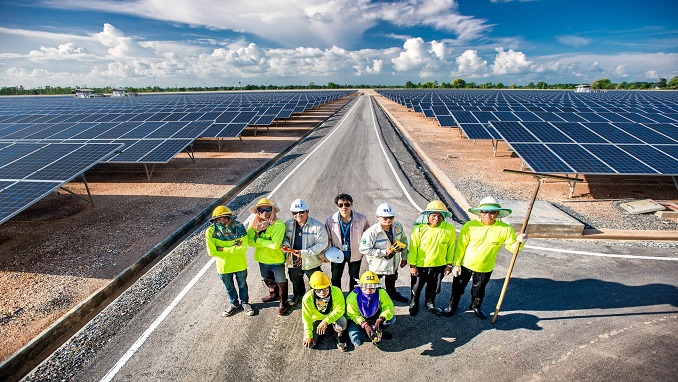
China has developed a robust domestic solar sector that could easily deliver a sustainable transition in Belt and Road countries. It has moved quickly in the past ten years to lead the world in solar power with at least 165 gigawatts across solar farms and distributed generation. China still derives 60 per cent of its power from coal but solar is increasingly competitive. In December, a 500 megawatt solar farm in western China started selling power at .316 yuan per kilowatt hour (~5 cents), beating the country’s benchmark price for coal power for the first time.
China has already exceeded its 2020 solar target by more than 50 per cent. This massive expansion was helped over the past decade by creative and flexible policy guidance, government subsidies for investment, successful R&D programmes, and a government consensus to significantly curb carbon emissions.
The experiences of government agencies, research institutions, and investors form a valuable toolbox that should be exported to rapidly developing BRI countries where a transition to renewable energy is pressingly required. The WRI report found that 31 Belt and Road countries needed about US$235 billion in investments to meet their emissions reduction commitments under the Paris Agreement.
Chinese solar diplomacy could help countries with a lot more than project financing. Solar is commercially competitive in Thailand and Vietnam but energy sector officials and utility operators there often complain that intermittent power is difficult to manage on national grids.
This is an area where Chinese expertise could help. China has a lot of experience managing the unwieldy expansion of renewables whether it’s adjusting targets on a gradual and flexible basis, changing subsidy structures or reducing power wastage. This shows an ability to deal with the necessary growing pains of a renewable energy transition.
Further, in 2016, China’s National Energy Agency announced a poverty alleviation initiative that provided financial incentives and technical guidance for installing rooftop solar in China’s poorest areas. It allows participating households to sell power back to the grid. The programme aims to help two million households in sixteen provinces earn an extra 3000 yuan per year (US$420) through government subsidies. It will also manage problems related to solar intermittency and structurally optimise the country’s power sector.
Electrification rates in BRI countries such as Cambodia and Myanmar are likely to still be around 50 per cent by 2020 without significant intervention. These countries would benefit from foreign assistance to alleviate poverty through solar rooftops and mini-grids in rural areas. Such programmes would also create opportunities abroad for domestic solar champions such as Suzhou Photovoltaic Technology Co. Ltd which has constructed more than one gigawatt of small-scale solar power plants through China’s poverty alleviation initiative.
Jennifer Turner, director of the Wilson Center’s China Environment Forum, argues that the Chinese government should be more vocal about its rural solar schemes.
“These projects not only electrify small communities but also create jobs in installation and maintenance of these small-scale energy projects. These kinds of successes should be interwoven into China’s BRI investments, especially in communities that are displaced by large dams, ports, or roads,” she said.
In Laos and Cambodia, resettlement related to infrastructure projects and displacement from economic land concessions are the top driver of internal migration. Providing resettled people with ample access to power will increase access to educational resources for community youth and underpin conditions for rural economic development. It could also help close gaps between rural and urban livelihoods in Belt and Road countries.
For many developing countries, building a competitive market environment where renewable energy generation reaches price parity with coal requires creative political leadership, physical infrastructure, effective management, and investments in national level transmission and distribution systems.
A programme of Chinese solar diplomacy in the context of the BRI would demonstrate to the world China’s intentions to become an ecological civilisation. So far, China has prioritised BRI countries with plans for significant coal expansion and those where free-flowing rivers provide critical natural resources. Chinese solar diplomacy could accelerate the expansion of solar capacity and create conditions for forward looking power systems which could integrate wind, biomass, and other forms of intermittent energy.
An effective solar diplomacy, if implemented, would greatly improve China’s position as a climate leader at a time when global carbon emissions are ticking upwards again, and potentially spur other actors to create a virtuous race toward a 1.5C future.
Big lenders such as the Asian Development Bank and the World Bank would likely be keen to partner with China on such efforts, building on previous pledges to find ways to co-finance projects with China’s Asian Infrastructure Investment Bank and other development agencies. Such a move would raise global confidence in the BRI as a force for sustainable development and help make good on China’s pledge to be a responsible global power.
Source Eco-Business