

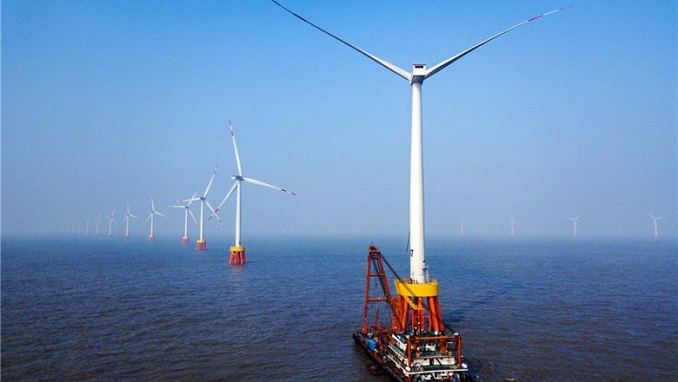

Clean energy, environmentally friendly technology, green infrastructure, planet-preserving finance and sustainable economic development on a global scale is achievable with sustained efforts, sharp focus, visionary policy and imaginative project implementation – that’s the takeaway for umpteen businesses participating in, and benefiting from, the China-led Belt and Road Initiative (BRI), experts have said.
The BRI is getting greener, they said. China spearheads the BRI to create transcontinental infrastructural and trade networks across land and sea routes, so as to deliver development and prosperity to billions of people around the world.
“With the deepening of the BRI, green development should be taken as a top priority, in addition to other key factors like gross domestic product and employment,” said Ma Jun, chairman of the Green Finance Committee of the China Society for Finance and Banking.
Ma made the remarks at a panel discussion during the World Economic Forum’s (WEF’s) Annual Meeting of the New Champions 2019. Known as Summer Davos, the event was held in Liaoning province’s Dalian city earlier this month.
The timing of his remarks coincides with China’s newfound focus on environmentally friendly development via the BRI, to be in line with the UN 2030 Agenda for Sustainable Development.
China’s stance is expected to inject fresh impetus into efforts for economic development in BRI economies. Green BRI is also part of China’s broader efforts to promote high-quality development. High-quality infrastructure construction will greatly improve environment and lead to high-quality economic growth, experts said.
China and other BRI economies reached a broad consensus at the forum on high-quality, green development. The country aims to bring greater development opportunities to other countries around the world through the BRI.
Jeffrey Wong, head of advisory at market consultancy KPMG China, said at Summer Davos: “During this process [of BRI-related development], Chinese companies are actively engaged in a lot of environment-related projects, such as renewable energy like wind and solar, clean energy including LNG and LPG as well as environment utilities.”
These projects have helped reduce consumption of energy and boosted the development of local economies, he said. For instance, Chint Group, a Chinese industrial electrical equipment and new-energy enterprise, is helping construct several hundred photovoltaic power stations in economies relating to the BRI. Photovoltaic, generated by solar cells, is a clean and renewable energy.
According to a report by the Global Development Policy Center’s Global China Initiative at Boston University, China’s investments in power generation have been “more green than black” over the past few years. Over 50 per cent of the country’s investments in power generation projects around the world are related to clean energy that has water, wind or the sun as the main source, the report said.
The total investment in energy projects in BRI-related countries and regions has reached $186.3 billion. Of this, the clean energy sector accounts for 26 per cent.
In Chile, South America, the first batch of 100 Chinese-made electric buses of BYD, which offer quiet, smooth, quick and green rides, are being inducted into the local public transport fleet.
Chilean President Sebastian Pinera said the nation hopes to cooperate with Chinese companies like BYD in clean energy. Chile boasts solar, wind and tidal energy resources and is in need of such projects that can exploit them, he said.
Besides technologies and expertise, effective financing is crucial for green development. The Asian Development Bank estimated that Asia would need $1.7 trillion of infrastructure investment annually between 2016 and 2030.
So, China has led the path of green finance by encouraging flow of capital into more sustainable projects. It helped found the Silk Road Fund in December 2014 to offer investment and financing support for trade and economic activities within the framework of the BRI.
The Chinese government contributed $40 billion to the fund and added 100 billion yuan ($14.5 billion) in 2017. By the end of last year, the fund had pledged to back 28 projects entailing investments of over $11 billion.
At the WEF’s Dalian event, Cambodian Minister of Public Works and Transport Sun Chanthol acknowledged the significance of this move. “It was not easy for most developing countries to get financing for road and railway construction, yet China-led BRI, including the Silk Road Fund, has offered a [helping] hand,” said the minister.
Another shining example of development-oriented finance is green bonds.
“China has been leading the region’s shift toward financing with green bonds . . . and has been at the forefront of using green bonds to finance sustainable development,” said Rajiv Biswas, Asia-Pacific chief economist at IHS Markit, in an article published in China Daily.
In 2016, China officially launched its green bond market and issued labelled green bonds worth 205.2 billion yuan. China was also the first country to make it compulsory for all listed firms and bond issuers to disclose the environmental, social and governance risks associated with their operations by next year.
Several large Chinese banks, including Industrial and Commercial Bank of China Ltd, Bank of China Ltd and China Development Bank Corp, have issued climate bonds.
This April, ICBC also issued its first green bond focusing on Belt and Road interbank cooperation. Offered in three currencies, the bond aims to support the development of green projects under the BRI and boost interbank cooperation in the region.
Media reported that China is by far the largest issuer of green bonds among the world’s emerging markets. Internationally aligned green bond issuance from China reached $31.2 billion last year, accounting for 18 per cent of global issuance, said a report published by the Climate Bonds Initiative and China Central Depository & Clearing Co Ltd.
Source The Phnom Penh Post