


Europe’s financial centres are teaming up to mobilise the vast sums of capital needed to meet global climate targets. Under a new Europe-wide initiative, green financial centres are aiming to significantly accelerate the shift to sustainable finance. Partnerships are crucial to mobilising the investments needed to meet the Paris Agreement – at least a doubling of the current annual investment rate in climate action to 2030. In Europe alone, some €177 billion in additional yearly investment between 2021 and 2030 will be needed to keep the increase in average global temperatures to well below 2C.
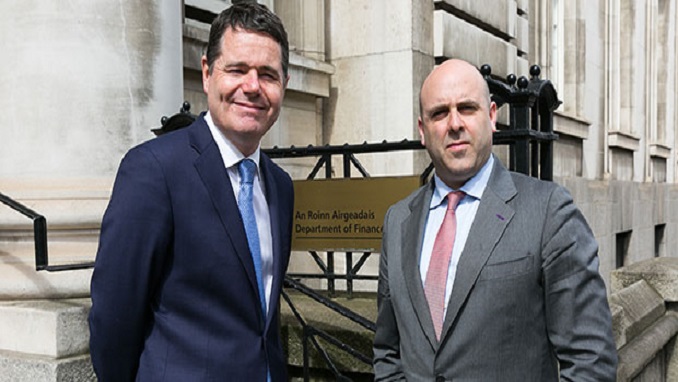
“Mobilising the world’s financial centres is essential to make progress on climate change and sustainable development,” said Irish Minister for Finance, Pascal Donohue when launching the EU Hub of the UN’s Financial Centres for Sustainability(FC4S) last month.
Local financial centres are well-positioned to promote the innovation, partnerships, and best practices needed to rewire finance for sustainability goals. As Nick Robins, co-director of the UN Environment Inquiry into the Design of a Sustainable Financial System, puts it:
“We see financial centres as a way to connect the high-level agenda with action on the ground.”
Taking green bonds as an example, he says: “It takes a village to raise a child and it takes a financial centre to issue a green bond. You need banks, stock exchanges, institutional investors and so on.”.
Issuing a sovereign green bond is exactly what Ireland is planning to do as part of a major push to invest in climate-aligned projects and solutions and put the country on the map as a key player in European and global climate finance. Dublin as a financial centre is also at the heart of efforts to create more strategic links between Europe’s financial centres on climate action. The city has been selected to host the European hub for the UN’s FC4S network, which is backed by a €1.5 million investment by EIT Climate-KIC, the EU’s largest public-private partnership addressing climate change through innovation. Scott Williams, Director of Sustainable Finance at EIT Climate-KIC, says:
“Investing in places matters if we want to create conditions for more rapid, mission-oriented innovation. The EU Hub of the FC4S is a part of Climate-KIC’s wider innovation ecosystems and systems innovation work – and part of a joined-up ‘portfolio’ of finance interventions. Through this hub, we aim to help set the standard for how sustainable finance should be practised going forward.”
FC4S brings together several Climate-KIC supported initiatives, including a Financial Centres Benchmark, developed by PwC and I4CE and launched in a preliminary version at the One Planet Summit last year. Stockholm Green Digital Finance’s Green Asset Wallet, also supported by Climate-KIC in its prototype development, will form an integral part of the digital programme of work under the FC4S. The European hub aims to mobilise action across more than 30 financial centres in Europe, with efforts to raise capability on sustainable finance, boost collaboration between centres, connect finance with real economy needs and stimulate proposals for new approaches that have the potential to catalyse exponential leaps in decarbonisation and resilience impacts.
“No one can make the leap into climate-compatible finance on their own, so at some point you have to collaborate.The EU sustainable finance action plan is at the heart of this – it is a very clear policy agenda,” says Stephen Nolan, CEO of Sustainable Nation Ireland, who has been appointed strategic advisor to the global network and will co-ordinate the European hub.
Robins agrees, saying the European FC4S hub will be “turbocharged by policy initiatives such as the EU Action Plan.” So what can financial centres do to help rapidly scale up capital that actually makes an impact?
“We’re developing a rich bag of tools,” says Robins. One of the initial focuses of the EU FC4S hub is to develop a common European benchmark to evaluate climate and sustainability credentials for financial centres. The idea of the benchmark isn’t to rank financial centres on their green credentials, Robins explains. Instead, it’s a way to establish how far individual centres have progressed on sustainability and climate and use this to stimulate further action.
“No financial centre is fully aligned with the SDGs or the Paris agreement,” he says.
“Some financial centres are only at the beginning [of their sustainability work] so, with Climate-KIC support, the hub will work with individual financial centres to help them develop a strategy and put in place a public-private sector process to execute against,” says Nolan.
“The greater number of European located Financial Centres on board, the quicker we can work together to mobilise the capital required to meet EU targets.”
To help financial centres become better positioned to promote sustainable finance, the EU FC4S hub is planning to launch an open innovation platform, building on the finance innovations already being supported by EIT Climate KIC in the centres.
“The initiative is somewhat in line with what some financial centres and innovation hubs do on a national level, where they often serve as a test-bed and learning environment. Taking it to a Europe-wide level can speed up the development of innovative instruments and new ways of working that can be scaled up and taken to multiple financial centres,” says Aaron Maltais, a Research Fellow within the Climate, Energy, and Society unit at Stockholm Environment Institute.
Now is also a great time to take advantage of the strong European policy agenda for sustainable finance, he explains, as it creates stable support for the transition to a sustainable economy that “isn’t dependent on current political structures but has a broader and stronger support but more financial centres – this is really helpful”.
The first gathering of Europe’s green financial centres is set for 6 – 8 November at the Climate Innovation Summit in Dublin Castle. Scott Williams added:
“We are looking forward to gathering together individuals from across Europe. This is the moment for EU financial centres to demonstrate real leadership. We have the mission, we now have the FC4S initiative. What we don’t have is time, but working together we can catalyse systemic change for climate action.”
Source Environmental Finance