


By Claire Jones
In this Alice in Wonderland world of negative rates, we are used to seeing things that look a little odd. Usually it’s because the concept of paying governments and companies to borrow still strikes us as a somewhat bizarre. This time, however, we have the opposite issue.
From Der Spiegel (emphasis and translation Alphaville’s):
There is another dispute over climate policy in the German coalition. The new spat is over Minister of Economics Peter Altmaier’s (CDU) and CSU country group leader Alexander Dobrindt’s (CSU) suggestion to launch a two-percent interest-climate bond. With the instrument, the two want to mobilise 50 billion euros . . . so that they can make climate-friendly investments.
At the conference of the executive committee of the parliamentary group of the CDU and CSU the suggestion was greeted positively, according to SPIEGEL information. Chancellor Angela Merkel, in particular, is said to have [supported the idea] . . . The proponents see the bond as a way to activate private capital for climate protection. Especially from small savers, to whom they want to offer them a comparatively lucrative investment opportunity in the current low interest rate phase . . .
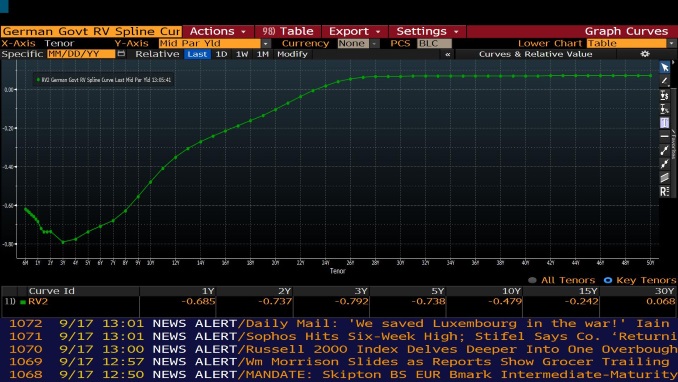
. . . Federal Finance Minister Olaf Scholz (SPD) rejects the measure . . . The interest on such a bond would be a gift for investors from the federal budget. After all, the federal government could currently borrow money on the capital markets for zero per cent and less.
Why on earth would the German government consider issuing a green bond with a coupon as high as 2 per cent? Let’s just remind ourselves what their yield curve looks like right now. Setting aside the fact that this is a clear vote-winner, is there any financial argument at all to justify this?
If — and it remains a big if — Berlin decides to go ahead with launching a €50bn green bond this Friday as part of a wave of measures aimed at stemming climate change, there are a few things worth bearing in mind about the price of the coupon.
The first is that reports suggest that the debt will not be like your standard Bund, but rather a citizens’ bond issued through a special purpose vehicle. That measure is presumably so that Germany manages to maintain its debt brake, a part of the constitution that — while allowing for some deficit spending — would not allow for borrowing on the scale that we are talking about here.
That means it may or may not have a federal guarantee, potentially making it riskier. It is also unclear what the conditions would be, and whether the bonds would need to be held to maturity with no secondary market. The devil may well be in the detail. But a premium of about 2.5 percentage points on the Bund?
We would argue that this is pretty high as we don’t think there is much risk of a nation this rich, with a debt-to-GDP ratio this low, of failing to honour this commitment. We would add that finding Germans who are also environmentally conscious is not too difficult.
When you talk to people working with family offices here, they say that their cash rich clients are often willing to pay a premium to invest in a business that is considered environmentally sound. We do not think this offer of a citizens’ bond risks being undersubscribed, even at a far lower yield.
In other words, we’re with Scholz on this.
It might win the CDU and CSU a few votes from the country’s savers struggling to find a return, while greening the party’s image at a time when they are neck-and-neck in the polls with the surging Greens. But from a financial perspective it makes no sense for Berlin to dole out €1bn in interest payments a year right now and, with the bonds likely to be bought by richer Germans, we would suggest doing so would also needlessly worsen inequality.
Indeed we find it somewhat maddening that they are even talking about it. Though that does provide some respite from being mad at our own government, we suppose.
Source Financial Times