

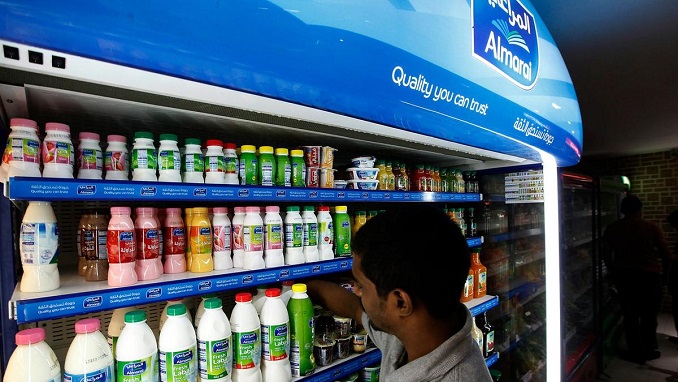

Almarai, the Arabian Gulf’s biggest dairy company, expects to issue a new sukuk before the end of 2018 as part of an ongoing debt refinancing strategy, its chief financial officer said on Sunday.
“We have no plans to grow our debt facilities – on the contrary, we are working on a process to refinance our existing debt, and are considering options for a new sukuk which we plan to issue before the end of the year,” Paul Gay told The National.
Banks have yet to be appointed and Mr Gay declined to disclose the size of the issue. The company paid back its previous capital sukuk of 1.7 billion riyals in September, and has around 12bn riyals of debt on its balance sheet, he added. The new sukuk would be used to “refinance existing debt.”
On Sunday, Almarai reported a 4.9 per cent annual drop in net profit in the third quarter of 2018, on higher cost of sales and a general contraction in the market. Net profit attributable to shareholders fell to 634.5 million riyals ($169.3 m), falling short of the 671m riyal estimate of one analyst polled by Bloomberg. Revenues fell 0.06 per cent year-on-year to 3.37bn riyals, Almarai said in a filing to the Tadawul stock exchange, where its shares are traded. However, revenues were above the 3.327bn median of two analysts polled by Bloomberg.
Saudi Arabia’s NCB Capital said the results were broadly in line with expectations.
“We believe key positives are: improvement in the performance of poultry operations, production efficiencies and cost optimisation initiatives. The drop in revenue growth was due to a “general contraction in the market coupled with an increase in product promotions and changes in the product portfolio and channel mix,” it said in an analyst note on Sunday.
The company’s profit fell due to an uptick in the cost of sales, in particular higher alfalfa prices to feed dairy cows, as well as increased promotions and labour costs.
“This has been partially offset by better cost management, stable commodity costs and enhanced production efficiencies,” the company added.
The GCC consumer goods market has been impacted this year by several negative trends including lower export sales on the back of a general slowdown in the region and the introduction of a 5 per cent VAT in the UAE and Saudi Arabia in January. In the kingdom specifically, implementation of an expatriate levy and structural economic changes have driven higher costs in energy and transportation and altered consumer demographics.
Almarai has grappled with such headwinds this year. In the second quarter it reported a 2 per cent year-on-year drop in net profit, attributed to the same ongoing issues of declining export sales, changes in demographics and an increase in product promotions, among other factors.
In the latest quarterly results, Almarai said net profit for its dairy and juice category decreased by 14.5 per cent year-on-year “due to adverse market conditions, slow performance of the market driven by VAT implementation, an expat exodus, higher alfalfa cost and reduction in export sales coupled with discounting and promotions.”
Source The National