

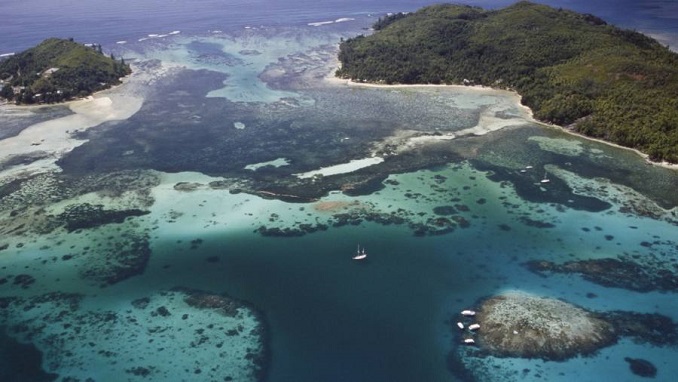

The tiny island nation of Seychelles has become the first country to raise funds in the bond markets to protect dolphins and other marine life, in a deal which also involves the World Bank and the Prince of Wales.
Seychelles is the first country to sell debt that is earmarked specifically for ocean projects, raising $15m in a 10-year ‘blue bond’ which is modelled on the green-labelled debt which first emerged a decade ago and has since grown into a $150bn-a-year market. The country received help in designing the bond from the World Bank, which pioneered the use of green bonds, and an environmental foundation set up by the Prince of Wales to work on sustainability challenges.
Arunma Oteh, vice-president and treasurer of the World Bank, said the blue bond was “an example of the powerful role of capital markets in connecting investors to projects that support better stewardship of the planet.” Although the amount raised was small, it acted as a proof of concept for the blue bond structure, she said:
“We hope that this bond will pave the way for others — much like the World Bank’s first green bond catalysed the green bond market 10 years ago.”
A record $155bn of green-labelled debt was sold in 2017, according to credit rating agency Moody’s, which forecasts that between $175bn and $200bn will be sold this year. The bond “will greatly assist Seychelles in achieving a transition to sustainable fisheries and safeguarding our oceans while we sustainably develop our blue economy,” said Vincent Meriton, vice-president of the Republic of Seychelles.
Seychelles is an archipelago of 115 islands and 1.4m sq km of ocean. Fish products comprise 95 per cent of its exports and the fishing industry employs 17 per cent of its population. The bond proceeds will be used to expand its protected marine areas, invest in fisheries and offer grants and loans to ocean-related industries.
Justin Mundy, former director of the Prince of Wales’ international sustainability unit, said the bond’s concept was conceived in 2014 with the unit’s help.
“The bond demonstrates that institutional investors can become involved in helping to build a truly sustainable blue economy that supports critical marine ecosystems,” he said.
Jennifer Pryce, chief executive of Calvert Impact Capital, one of the three investors who bought the bond, said there was an “urgent” need for capital “to address threats to the health of our ocean.” The bond’s structure is a way to “align marine conservation and economic opportunity,” she said.
The other investors who bought into the bond were Nuveen — a subsidiary of asset management giant TIAA — and Prudential Financial. Stephen Liberatore, manager of Nuveen’s ESG fixed income strategies, said climate change had “created both challenges and possibilities for investors.”
“Investing with a responsible approach is both prudent and financially rewarding in the long term,” he said. “We hope this transaction serves as a template for creative impact investment solutions in the future.”
The financing structure blends commercial and non-commercial funding sources — the bond is backed by a $5m guarantee from the World Bank, and a $5m concessionary loan from the Global Environment Facility, an international financing partnership backed by governments and other organisations, will partly cover the interest payments.
The bond pays a 6.5 per cent annual coupon to investors, but the GEF loan will reduce the cost to Seychelles to 2.8 per cent. It is Seychelles’ second foray into environmental finance: earlier this year the country created two new marine protected areas as part of a 2016 deal to write off $20m of its debt.
Source Financial Times