

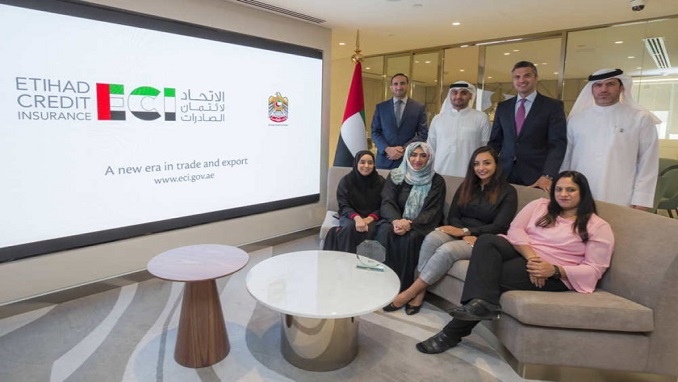

ECI Islamic, a Shariah-compliant trade credit and export finance insurance suite of products, was launched by Etihad Credit Insurance (ECI) at TXF MENA Virtual at the end of October.
ECI is the UAE Federal export credit company which is mandated to increase diversification in non-oil trade. UAE is playing an increasing role in world trade, and specifically in halal trade worldwide.
ECI may be a new player, established a full century after the first export credit agency (ECGD in 1917, currently UKEF), but it has the unique potential to develop trade financed according to Shariah law.
“As ECI stays true to its mandate of supporting the UAE’s non-oil sector in line with the vision of the wise leaders, ECI Islamic offers Shariah-compliant trade credit, finance and investment solutions in order to provide Islamic businesses a competitive swing in the international market,” says Zishan Iqbal, Director of Murabaha Solutions at ECI.
ECI Islamic is designed to boost the UAE’s halal export industry and to push its strong position as a global leader in the fast-growing Islamic economy and ECI is one of the first sovereign export credit agencies in the Middle East to offer Shariah-compliant export credit insurance and guarantee solutions.
This aspect of ‘Etihad’ (togetherness, cooperation) is the financial dimension of the expanding consumer Muslim halal culture which has broadened beyond the food sector into the pharmaceutical and lifestyle industries.
Specifically, through its use of Shariah compliant financial mechanisms and products, ECI aims to be recognised as the leading innovative world class ECA in the Middle East and throughout the world where Islamic companies trade and their banks operate.
ECI has worked in partnership with the Dubai Islamic Economy Development Centre (DIEDC) to develop its offering and the suite of ECI Islamic products has been signed off as Shariah-compliant by Dar Al Sharia, a Dubai consultancy firm consisting of professionals with expertise in Sharia, law, banking and finance.
The portfolio is re-insured by the Islamic Corporation for the Insurance of Investment and Export Credit (a member of the Islamic Development Bank) which is the only agency to offer such services for the member countries of the Organisation of Islamic Cooperation.
ECI Islamic aims to address the needs of four customer segments: banks, investors, large corporates and SMEs. Export credit solutions offered under the ECI Islamic banner include trade credit insurance (which includes whole turnover policy, single risk short term policy, and single risk long term policy), Letter of Credit confirmation insurance, Islamic export finance, foreign investment insurance, and surety bonding.
Risk sharing at the heart
At the heart of ECI Islamic is the concept of risk sharing – rather than risk transfers – and transparently sharing the surplus generated in the future. There are two separate funds associated with the products – one a pooled policy holder fund, and the other a shareholder fund.
Banks globally will be able to use the product. At the outset, ECI Islamic is targeting Islamic banks, and conventional banks that have Shariah-compliant products through dedicated windows.
“We are not limiting ourselves and we are willing to collaborate with banks that have Shariah-compliant solutions,” says Iqbal.
Collaboration with other ECAs on Islamic solutions?
Does ECI plan to help other ECAs access the Islamic finance market? ECI has already been partnering with multiple ECAs – including SACE, UKEF and Sinosure and is in discussion with other leading ECAs, Iqbal says.
“The aim is that if a transaction meets the eligibility criteria of the ECAs concerned, ECI can issue cover based on Islamic and Shariah principles and our partners can stand at our back and reinsure us,” he adds. “We have that capability and our proposition is end-to-end Islamic.”
Benefiting from the trusted ‘halal brand’
According to ECI the global halal industry has gained substantial traction over recent years. The Pew Research Centre estimates that by 2050, the number of Muslims worldwide will grow from today’s 1.7 billion to 2.76 billion, comprising 29.7% of the world’s population.
Their growing number has also resulted in growing halal and Islamic faith-inspired ethical consumption needs. In the 2019 State of the Global Islamic Economy Report released by US-based research and advisory firm DinarStandard, the halal spending of Muslims reached $2.2 trillion in 2018, spread across the food, pharmaceutical and lifestyle sectors.
The report also projected this number to increase to $3.2 trillion in 2024. Halal products are also being used by non-Muslims.
Iqbal is keen to point to the opportunities that stretch beyond simply the use of the products for religious reasons.
“Halal and Islamic solutions have become a brand – a brand of trust, of corporate social responsibility, of transparency and a brand of sharing the risk and moral values,” he says.
The broader picture in a COVID environment
To counteract the current crisis, ECI’s CEO Massimo Falcioni points out that ECI has increased financial and insurance guarantees without increasing fees. It has more than 1600 revolving credit guarantees of US$1.2 billion equivalent to support the non-oil economy.
During tough times, its commitment has increased, he says. Prior to the crisis (in August 2019), ECI launched specific support to SMEs in the form of an online solution ‘SME Protect’ which provides simple to access support via an OTC product helping businesses broaden their understanding of trade credit solutions and providing guarantees to receivables so SMEs can provide credit to clients without financial loss.
Encouraging investment through flexibility
ECI is flexible on local content requirements, adds Iqbal. “If you look at some global ECAs’ eligibility criteria, some are quite strict, wanting 100% and some only want 20%. Given the dynamics here on the ground in UAE, we can be more flexible. [UAE has] a lot of re-exports and a lot of companies use us as a hub for Asia and Africa in particular. We are [happy] to look at each transaction and at how it contributes to the GDP of UAE, it can go down as far as 10% as long as it is exported and re-exported from UAE.”
ECI is also providing support to incoming projects, particularly in renewable energy, waste management and greenfield projects. While not a member of the OECD, the OECD Arrangement will sometimes provide a good template basis for ECI to use, although it will also be flexible on this.
Meanwhile, Falcioni remains optimistic amid the looming synchronised global recession. He argues that in these unprecedented times, the past is not always a good guide as macroeconomic forecasts are based on models that will have inputs skewed by past projections.
“The UAE has proven to be very a resilient economy during the crisis with a very agile and visionary government which is looking to implement 17 Sustainable Development Goals (SDGs) as its first mandate; the vision for UAE’s Energy 2050 policy is to reduce carbon/fossil dependency. UAE is a country looking forward thanks to its inspired leadership. Retreat is never an option, looking forward with optimism is the key to success,” Falcioni said.
Source TXFNews