

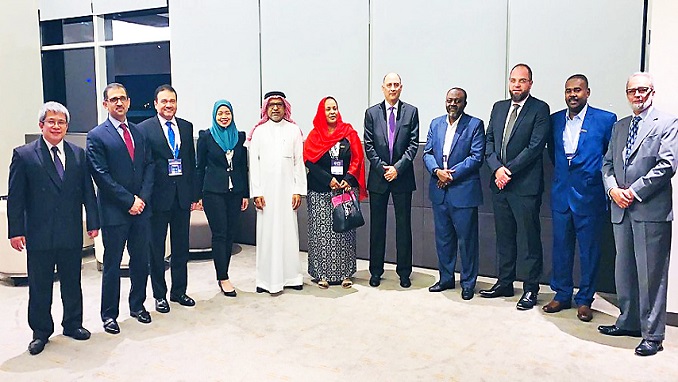

THE 39th meeting of the Board of Directors of the International Islamic Financial Market (IIFM) convened in Bahrain recently. It was attended by representatives from its founding and permanent members of the Central Bank of Bahrain (CBB), Bank Indonesia (BI), Central Bank of Sudan (CBOS), Autoriti Monetari Brunei Darussalam (AMBD) and the Islamic Development Bank (IsDB) as well as representatives of member financial institutions on the Board of IIFM.
According to the AMBD, in a press release yesterday, the Board recognised that IIFM’s efforts have contributed in facilitating trade flow, particularly in the cross-border market, through its standardised documentation and product templates on Islamic Hedging and Liquidity Management, by providing efficient, transparent, cost-effective and widely accepted Syariah-compliant financial documentation standards.
Chairperson of IIFM Khalid Hamad Abdulrahman said the IIFM has gained much credibility and has reached a stage of maturity with sound achievements today, but cautioned that there is still a burning need to get its standards to be used more actively by wider market players, which can only happen if there is a strong endorsement from regulators, particularly those in Islamic banking markets across Gulf Cooperaton Council (GCC) and Asia, he said.
AMBD said a survey carried out by IIFM highlights a marked increase in use of IIFM Standards by financial institutions and other market players active in Islamic finance.
However, they said more penetration is still required to reach the desired implementation levels. As part of its three-year Strategic Plan (2017-2020), IIFM in 2018 embarked on an awareness programme on its standards by holding several awareness seminars supported by regulators in Bahrain, Kuwait, the UAE and Malaysia, and will continue with these efforts by organising more seminars and round tables supported by regulators in different jurisdictions in 2019.
To further improve the outreach of its standards, translation of IIFM Standards in other languages starting with French, Bahasa Indonesia and Turkish was approved at the meeting and the Board also acknowledged the progress being made in collaborating with consultants and training institutes for providing training materials on IIFM Standards.
Two new standards to be published soon by IIFM were also discussed at the meeting. It is expected that these standard framework documentation relating to trade finance will pave the way in increasing Shariah-compliant trade related activity and will help the smaller institutions to participate in trade finance transactions generated by large institutions.
Apart from these, two more standards are currently under development at the IIFM covering Sukuk Al Ijarah and Sukuk Al Mudarabah documentation which will help in reducing the cost and time associated with Sukuk issuances. These standards will also be supported by guidance notes for clarity and transparency and will be published in 2019.
Other initiatives to be embarked upon by IIFM during 2019 were also considered such as the development of standardised gold related documentation to be used by financial institutions active in Syariah-compliant gold business in collaboration with relevant international bodies.
“Collaboration with other Islamic and international standard-setting organisations is necessary as with combined efforts we can achieve greater unification and legal certainty to bring about more innovation, capacity building and market development,” said Chief Executive Officer of IIFM Ijlal Ahmed Alvi.
The challenges facing development of an Islamic benchmark reference rate and the need for further research in this area was also deliberated at the meeting.
IIFM will soon organise a roundtable discussion on this important topic sponsored by The Waqf Fund (Bahrain) which will be attended by key regulators, bankers, Shariah scholars, researchers and academics to discuss this subject from a theoretical and practical point of view.
AMBD said by being a member of the IIFM, Brunei Darussalam is able to leverage on the templates and standards introduced to ensure that the Shariah regulatory framework and policies issued by AMBD are according to international best practices and standards.
The IIFM is a standard-setting body of the Islamic Financial Services Industry (IFSI) focussing on the standardisation of Islamic financial contracts and product templates relating to the Capital and Money Market, Corporate Finance and Trade Finance segments of the IFSI.
IIFM, which is based in Bahrain, and hosted by the CBB, was established in 2002 as a neutral and non-profit infrastructure development institution, the collective efforts of IsDB, AMBD, BI, Bank Negara Malaysia (delegated to Labuan Financial Services Authority) and CBB.
Source Borneo Bulletin