


Human Rights organizations, as well as corruption and organized crime watchdogs have released stunning information about Trafigura Pte Ltd’s involvement in a scam using American aid to the South Sudanese government. The money has been misused to provide weapons that fuel the conflict in that country, but were intended by the U.S. to provide a program to establish farms.
Kristine Akodit, a mother of three, says “[h]unger is here” and her children sometimes go without food for days. She maintains that this year is worse than last year. Almost seven million South Sudanese people face hunger (approximately sixty-one percent of the population, including 1.8 million close to starvation).
The crisis is largely a consequence of the civil war that broke out in South Sudan in 2013 shortly after it gained independence from the government in Khartoum, the capital of Sudan. While South Sudan’s civil war started as a power struggle, it escalated along ethnic lines, killing almost 400,000 people and displacing millions.
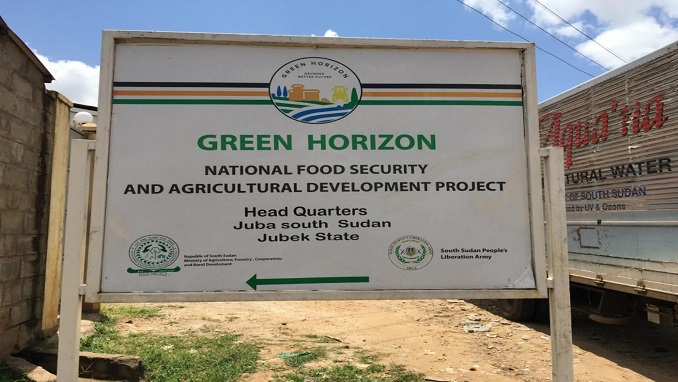
In 2015, the South Sudanese government launched a multi-million dollar agricultural project with American aid. The aim was to conquer the high percentage of starvation among the citizens, create jobs, and yield considerable agricultural results to aid the country’s economy through exportation.
But according to the U.S. government, the farming project was instead used to cover up the sale of approximately US$150 million in weapons, including rifles, grenade launchers, and shoulder-fired rockets. In December, an Israeli security services firm contracted to run the project, as well as its owner, were blacklisted for allegedly fueling the conflict by supplying arms to both the government and the opposition. In its sanctions announcement, the U.S. Treasury Department mentioned — but didn’t name or blacklist — a ‘major multi-national oil firm’ that was in ‘close collaboration’.
Newly leaked internal documents, emails, and records obtained by OCCRP (Organized Crime and Corruption Reporting Project), as well as confirmation by two closely placed sources, show who that collaborator is likely to be: Trafigura Pte Ltd., an oil trading subsidiary of Trafigura Group Pte Ltd., one of the world’s largest commodity trading companies.
The materials show that Trafigura transferred at least $140 million to South Sudan’s central bank, ostensibly as pre-payments for crude oil. They also show that the government then transferred nearly the same amount to sanctioned company Global CST (an Israeli- based company that provides defense and security services to governments and international organizations). The transfers go far beyond the $45 million allocated to the farming project, called “Green Horizon”.
The total amount transferred nearly matches the $150 million worth of arms the Treasury Department said Global CST’s owner sold to the government.
Trafigura did not respond to specific questions about whether its money may have been used as payments for arms. However, Trafigura has recently surfaced in a separate story about secret money transfers. The money paid to the Green Horizon farming project never showed up in the government’s budget, a lack of transparency troubling to human rights watchdogs.
“When multimillion-dollar deals are kept off the books and oversight institutions are sidestepped, the money’s either being used to line the pockets of politicians or support military operations,” said J.R. Mailey, Investigations Director at The Sentry (a Washington-based advocacy group that investigates links between war crimes, corruption, and human rights violations).
The project shows how “multinational companies are benefiting from the violence of South Sudan,” said Edmund Yakani, executive director for Community Empowerment for Progress Organization, a local advocacy organization.
Source: https://www.occrp.org/en/investigations/sprouting-weapons-of-war